What is the key to combining advanced facilities and scientific knowledge for the improvement of patients’ lives? Modern Research Laboratories are one of the main engines for making medical discoveries because they isolate new chemical structures and develop targeted treatments. Additionally, they optimize drug formulations in order to maximize bioavailability and reduce side effects. All these activities allow closing the gap between molecular biotechnology and clinical practice.
Indian facilities actively promote the local production of complicated biologics, APIs and affordable generic drugs. Thus, the state-of-the-art pharmaceutical research laboratory is a key to overcoming the challenges of global healthcare. By integrating artificial intelligence into the first stages of testing, these advanced laboratories significantly reduce clinical drug development times and maintain strict compliance.
How Do Research Laboratories Drive Breakthrough Drug Discovery and Development?
Scientists need infrastructure in order to systematically isolate bioactive chemicals and design targeted molecules. For this reason, modern research laboratories use high-throughput screening to evaluate thousands of chemical reactions at once, speeding up the first stages of testing.
- Scientists actively use genetic sequencing for the detection of disease-causing cellular pathways.
- Scientists design customized chemical molecules to interact with biological receptors.
- Automation allows testing for thousands of drug candidates each day.
- Using sophisticated computer algorithms, one can predict the behavior of novel molecules in human cells.
- Teams perform careful analysis of the molecular stability under various environmental conditions.
Ultimately, all these actions convert theoretical chemical discoveries into medicine. With the help of such a disciplined approach, Drug Discovery Research provides a foundation for further clinical trials.
Why Are Advanced Research Laboratories Essential for Modern Healthcare Innovations?
Acceleration of Target Identification Processes
Scientists isolate proteins responsible for the disease and create inhibitors to block their activity. Thus, a dedicated pharmaceutical research laboratory uses advanced computing systems to model molecular interactions.
Improving Precision Medicine Formulations
Modern treatments must be adjusted according to the patient’s genome. For this reason, a modern Research Laboratory in India uses advanced genomic mapping technologies for developing personalized therapies for complex oncological diseases.
Increasing Scale of Synthetic Chemistry Production
Development of medicine from the laboratory compound into a mass product requires special knowledge in chemical engineering. Thus, pharmaceutical innovation is possible due to the sophisticated pilot plants for optimizing the chemical synthesis process.
Optimization of Vaccine Delivery Systems
New mRNA therapies and biological proteins require advanced nanoparticle protection shells for functioning in human bodies. Therefore, advanced Healthcare Research and Development institutions develop specialized lipid containers for transporting active ingredients of medicine to the target organs.
Automation of Pre-Clinical Assessment Workflows
Manual chemical testing often leads to human errors and slows down regulatory approval. Consequently, modern research laboratories apply automated robotic systems that can perform non-stop safety profiling, which allows for reducing early-stage development costs.
How Do Pharmaceutical Research Labs Improve Treatment Safety, Quality and Effectiveness?
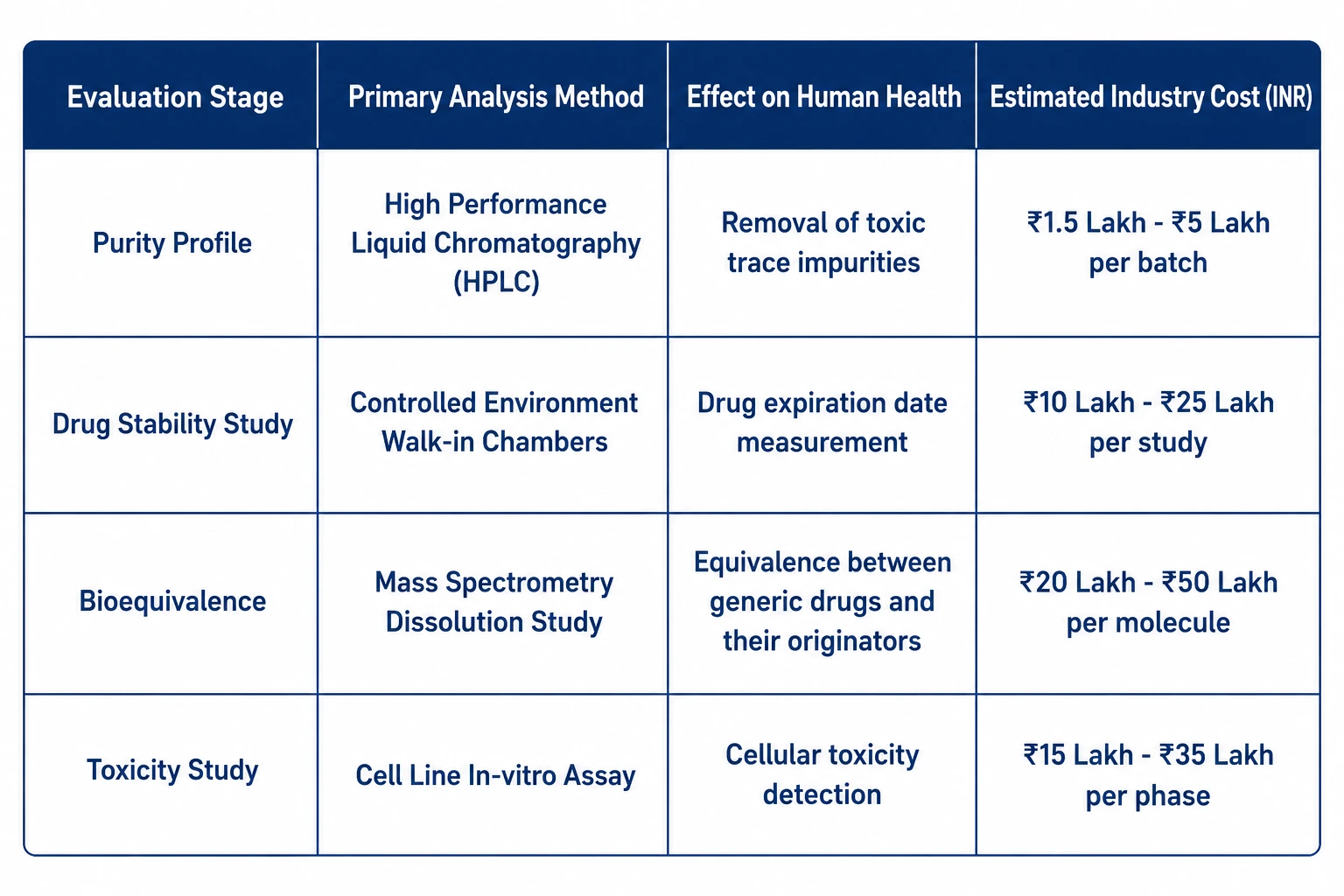
For the sake of public health, scientific facilities apply a strict testing matrix in all stages of development. The table below shows how dedicated laboratories handle quality control, structural evaluation, and regulatory requirements.
Why Chemzin Biotox for Reliable Research and Pharmaceuticals?
World-Class DSIR Recognized R&D Facilities
Our advanced infrastructure meets the international standards to produce verified high-quality analytical data. Additionally, a state-of-the-art Pharmaceutical Research Laboratory uses advanced chromatography equipment to ensure analytical precision.
More Than a Decade of Proven Contract Research Expertise
We consistently help international healthcare companies navigate complex regulatory pathways with accuracy and speed. Therefore, our deep expertise in drug discovery research allows us to optimize formulation development processes and minimize the barriers of market entry.
Cost-Effective Chemical Synthesis Protocols
We design the highly optimized and scalable manufacturing processes that minimize the waste of raw ingredients during production scale-up. Thus, our premier research laboratory in India saves clients up to 40% of the cost of commercial-scale chemical synthesis.
Comprehensive Toxicology and Safety Testing
Our certified testing panels provide authentic and verifiable data that satisfy the strict global regulatory clearance parameters. Thus, we accelerate Pharmaceutical Innovation with flawless and audit-ready safety documentation for global filings.
End-to-End Molecular Development Portfolios
We manage every stage of the product lifecycle, starting from its conceptual design until commercial validation. Through this comprehensive approach, our dedicated healthcare research and development division ensures that therapeutic discoveries successfully become market leaders.
The Bottom Line
Thus, modern research laboratories are the cornerstone of progress in the global healthcare sector. They help to identify microscopic disease pathways and to execute strict quality control assays. With the help of advanced automation, predictive computing, and precise molecular tracking, modern science manages to solve unmet medical needs around the globe. As an industry leader, Chemzin Biotox constantly invests in top-tier analytical infrastructure, advanced synthesis tools, and a qualified scientific workforce.
Frequently Asked Questions
Q1. How do research laboratories speed up commercial drug development timelines?
Ans. They apply automated high-throughput screening to test thousands of chemical structures rapidly. As a result, this advanced method allows reducing the time of initial molecular testing from several years to just a few months.
Q2. What is the role of a pharmaceutical research laboratory in the production of generic medicines?
Ans. These specialized facilities perform detailed bioequivalence studies in order to match generic molecules with originators. Thus, they make sure that generic medicines are equally effective and safe.
Q3. Why is pre-clinical drug discovery research important for patient safety?
Ans. This step helps to identify potential toxicity and side effects before the human clinical trials start. Thus, this preliminary verification prevents dangerous chemical formulations from entering human testing.
Q4. How do top-tier research laboratories lower global healthcare costs?
Ans. They develop highly efficient and scalable chemical synthesis processes that reduce ingredient costs. Thus, they allow the production of affordable treatments for global healthcare markets.
Q5. What is the pharmaceutical innovation in modern molecular therapy?
Ans. It is the development of targeted delivery systems, like lipid nanoparticles, to increase drug absorption. Thus, these structural innovations allow the use of low doses for achieving better clinical results.
Q6. How does healthcare research and development deal with antimicrobial resistance?
Ans. Scientists modify existing antibiotic chemical structures in order to break bacteria’s defensive mutation barriers. Thus, these modified chemical structures successfully eliminate resistant bacteria.
Q7. What analytical tools do research laboratories use for discovering trace chemical impurities?
Ans. They apply high-performance liquid chromatography with the help of ultra-sensitive mass spectrometry. Thus, they are able to discover and eliminate microscopic toxic impurities down to parts-per-billion levels.
Q8. Why do research laboratories need environmental stability chambers?
Ans. These chambers allow simulating extreme temperature and humidity conditions in order to detect compound degradation patterns. In this way, scientists establish the rules for storing compounds and set accurate expiration dates in diverse climatic zones.
Q9. How do drug discovery research teams optimize poorly soluble therapeutic molecules?
Ans. They develop special solid dispersion and self-emulsification systems in order to increase dissolution rate. Thus, this structural optimization helps to improve drug absorption in the human gastrointestinal tract.
Q10. What makes a research laboratory in India globally competitive in contract manufacturing?
Ans. They combine a highly skilled scientific workforce with internationally audited world-class testing facilities. Thus, they provide top-tier regulatory documentation at a fraction of Western operating costs.